
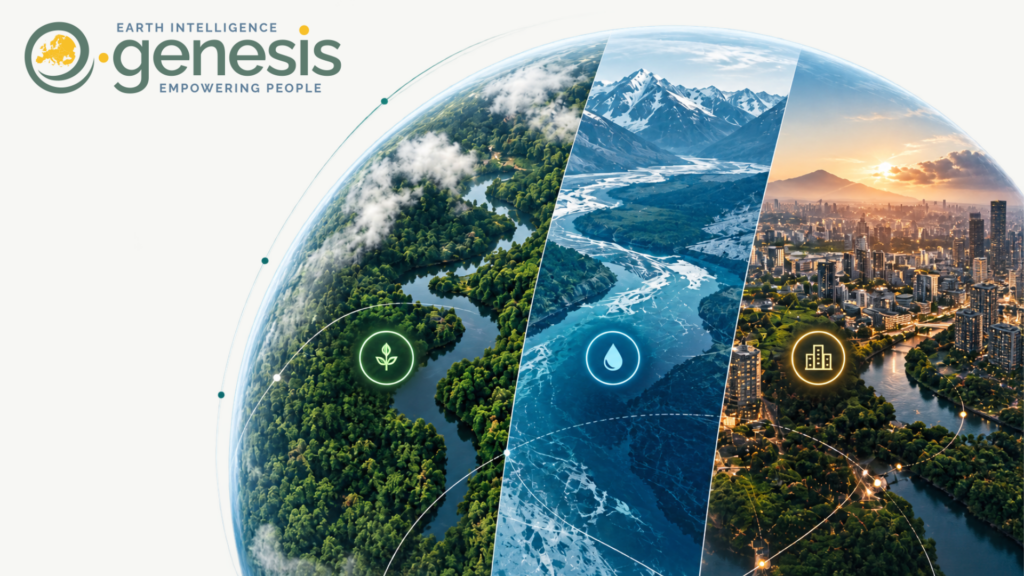
Europe confronts the steep costs of climate change—in lives lost, dwindling water resources, and cities struggling under extreme temperatures. With global temperatures hitting near-record levels, governments can no longer rely on reactive policies. Transitioning from reaction to prediction requires leveraging integrated Earth Intelligence, seasonal early warning, and coordination across sectors and governments.
To achieve this goal across Europe, the EU Invests €7.5 Million in Earth Intelligence with “e-genesis” Innovation Action (Generating Earth iNtelligence for Environmental and Sectoral Impact and Sustainability), a new Horizon Europe project coordinated by the National Observatory of Athens (NOA) through its Operational Unit “BEYOND Centre for Earth Observation Research and Satellite Remote Sensing”.
The Scope
“e-genesis” supports European governments and the European Commission to draw strategic policy decisions for protecting citizens, cities, natural ecosystems, societal health and critical infrastructures, while confronting the pressure due to deadly heatwaves, extreme floods, prolonged droughts, water and energy scarcity, biodiversity losses and worsening air pollution. To help meet these major challenges, “e-genesis” builds Europe’s next generation of Earth Intelligence—transforming Earth Observation, AI and environmental modelling into trusted operational services that predict seasonal environmental risks at high spatiotemporal scales. There are 30+ integrated solutions to be opened for the daily support of governance across sectors in three (3) thematic axes:
- Biodiversity Resilience and Informed Management of Protected Ecosystems: What is the critical extent of climate-driven disruption to natural ecosystems and wetlands in Europe over past decades, and what impact levels are projected for the next season based on current seasonal forecasts?
- Water Resilience Seasonal Outlook: Will water supplies be sufficient in the next season to satisfy drinking, industrial, agricultural, and hydroelectric demands? Europe is experiencing mounting water stresses. What precise volumes will be available from snowmelt, groundwater storage, and river runoff across the continent to help manage these heavy demands and mitigate acute water stress?
- Resilience of Urban and Energy Sectors to Climate and Anthropogenic Disasters: How resilient are Europe’s urban and energy systems to climate and anthropogenic disasters, and how can Earth Intelligence support climate-smart urban planning and household energy security? How can building-block-level intelligence anticipate sharp declines in solar andγ wind energy availability while reducing heat stress, air pollution, and greenhouse gas (GHG) emissions to improve citizens’ quality of life?
Starting on 1 November 2026, this 40-month collaboration, brings together under BEYOND/NOA coordination, 20 leading organisations from 10 European countries, including 13 major research technology trailblazers (BEYOND/NOA, MINES Paris PSL, IUSS, KTH, FONDAZIONE CIMA, FMI, FORTH, CBK PAN, CNRS, GFZ, CNR, PMOD WRC), 6 pioneer SMEs (EDGE, AG EUROPE SAS, SNOWCAP, SPATINEO OY, MURMURATION, WeMET), 1 industrial partner (CLS) and 1 governmental agency (NSO).
Empowering People and Governance through Co-Design
What “e-genesis” delivers is to benefit communities from local neighbourhoods and cities to broader regions and European nations. Each “e-genesis” service is co-developed alongside the professionals and communities who will ultimately use them—including policymakers, public authorities, user groups, industry leaders, and Europe’s entrusted entities (e.g. EUSPA, EUMETSTAT, ESA, EEA). By bridging the gap between scientists and decision-makers, “e-genesis” ensures its solutions are ready for immediate real-world deployment. This collaborative approach directly supports the implementation of Europe’s core environmental and climate priorities—such as the European Green Deal, the EU Biodiversity Strategy 2030, the Water Resilience Strategy, and the Zero Pollution Action Plan—where they matter most.
DG RTD has entrusted the role of e-genesis Project Coordinator to Dr Haris Kontoes, Research Director at the National Observatory of Athens. As he states:
“More than just delivering innovative services, “e-genesis” seeks to establish a new European paradigm for transforming environmental information into trusted knowledge that helps governments anticipate risks, protect people, natural resources, and ecosystems, and make better decisions before crises unfold. That is the future of environmental governance, and that is the ambition of “e-genesis”.